

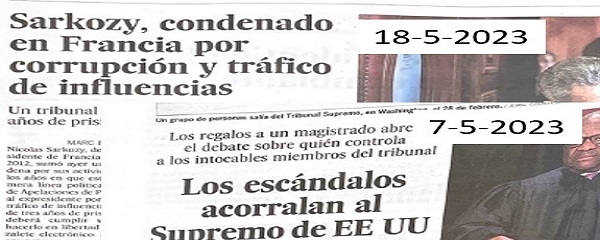
Leaf through the Spanish press and you might conclude that corruption is a foreign phenomenon: supreme court justices under suspicion abroad, former presidents convicted across the Pyrenees. Are there no senior judges or former leaders under suspicion here? The difference lies not in the honesty of our leaders, but in our system's inability to investigate them and report it.
Corruption is always somewhere else
Within a few days, national headlines may report suspicions of corruption at the United States Supreme Court or the conviction of a former President of the French Republic. These are newsworthy stories, and it is right to publish them. What is striking is the contrast: when suspicion points at our own top institutions, the spotlight goes out.
A naive reader would deduce that the corrupt are all abroad. An attentive reader will ask the awkward question: does Spain really have no senior judges or former rulers whose conduct deserves investigation? The answer is obvious. What is grotesque is the cause: a political, institutional and media system incapable of trying or exposing it.
Reading between the lines
News about other countries' corruption should be read for what it really is: proof that elsewhere there is a system of justice and accountability that works. There, judges, prosecutors and journalists are able to name and try their own powerful figures. What this should awaken in us is not complacency, but healthy envy.
The lack of investigative journalism into our own dirty laundry, especially where the judiciary is concerned, reveals a media ecosystem too close to power, if not captive to it. We have conveyed to international press associations our surprise that no journalist in Spain is being pursued for uncovering judicial corruption, and the reply we received was, in essence, that Spain has no such problem. The country's image abroad seems to overlook what happens inside its institutions.
A press under pressure
The diagnosis is not ours alone. Reporters Without Borders, in its Spain profile within the World Press Freedom Index, warns of a climate of judicial pressure on journalists: complaints for disclosure of secrets or defamation brought by politicians and judges, and a rise in abusive lawsuits known as SLAPPs. In the 2026 edition, Spain ranks 29th out of 180 countries.
Added to this is a framework that discourages investigation:
- Procedural privileges that keep senior office-holders away from the ordinary courts and raise the cost of reporting them.
- A Prosecutor's Office whose head is appointed on the Government's proposal.
- Criminal complaints and lawsuits that turn whistleblowers and journalists into defendants.
- Public broadcasters whose governing bodies, according to the same organisation, lack the independence recommended by European law.
The long process of waking up
Four decades of privilege cannot be dismantled overnight. That neither the Anti-Corruption Prosecutor's Office nor the major media echo complaints concerning the top of the judiciary says a great deal about the real degree of freedom and rule of law we enjoy. But it also points the way: if institutions do not investigate, organised citizens will have to drive the effort.
A country is not cleaner because its scandals stay out of the newspapers, but because they are investigated when they surface.
Waking up is a slow process, but an unstoppable one. That is why we call for:
- An ambitious transposition of the European directive against strategic lawsuits aimed at silencing public participation (anti-SLAPP).
- Effective protection for whistleblowers and journalists under Law 2/2023.
- Genuine independence for the Prosecutor's Office and public media.
- A press willing to look inwards with the same energy with which it looks abroad.
Every reader who learns to read between the lines is a step towards a country that does not need to look abroad to find the villains. Stay informed, share and join ACCYDED: we are working on it.